
This Staple Crop Is Fueling The Climate Crisis
These 2 startups are fixing it


Today’s sustainable snapshot👇🏽
This Staple Crop Is Fueling The Climate Crisis
Quiz of the Week
Startup 1: Mitti Labs
Startup 2: Rize
What Else Did I Publish Recently
This Staple Crop Is Enabling The Climate Crisis
For billions of people, this is a staple crop. It feeds more than half the world.
If you haven’t guessed by now, we’re talking about rice.
If you’ve ever read about (or seen) rice fields, you’ve probably noticed they’re flooded. That’s why they’re also known as rice paddies (a paddy is a flooded, enclosed field).
While these flooded soils are great for growing rice, they also create ideal conditions for microbes that release greenhouse gases, making rice fields (and rice) a growing driver of climate change.

And since billions of people eat rice, and that number is growing, two things are happening:
The rice cultivation areas are increasing
In the existing fields, more intensive practices are used to increase the yield
Farmers are also using more synthetic fertilizers, and even organic ones like straw and manure. They’re fitting more crops into the same field and growing them closer together. On top of this, rising global temperatures are increasing microbial activity, which thrives in these rice fields.
Many farmers also leave rice stalks in the field and plow them into the soil to improve soil fertility. But this increases the organic matter in the soil, which microbes then decompose — creating more methane emissions.
All of these activities compound into higher emissions.
So, if we know the problem, why aren’t we moving straight to solutions? Well, it’s complicated.
There are ways to reduce these emissions:
Reducing fertilizer use and residue application
Allowing dry periods instead of keeping the fields flooded throughout
Allowing only moderate amounts of straw and other crop residue in the field
Converting crop residue into biochar before mixing it into flooded soils. It can help stabilize soil carbon and reduce methane emissions.
But none of these solutions is a silver bullet. Many have limits, and they also depend on the region where rice is grown.
For instance, using moderate amounts of straw is OK, but too much can increase methane emissions and lead to carbon loss from the soil. Similarly, while reducing tillage seems like a good option, a recent study found it does not always minimize net emissions in flooded systems.
There are brands helping farmers find the right strategy so they can continue feeding the world while reducing associated emissions. I have covered two of them below.
But before that, it’s time to test your knowledge (or deduction power):
⌛ Time for the quiz of the week
Note: Answer at the end of the newsletter. No one (including me) can see your response, so feel free to vote. 😉
Mitti Labs
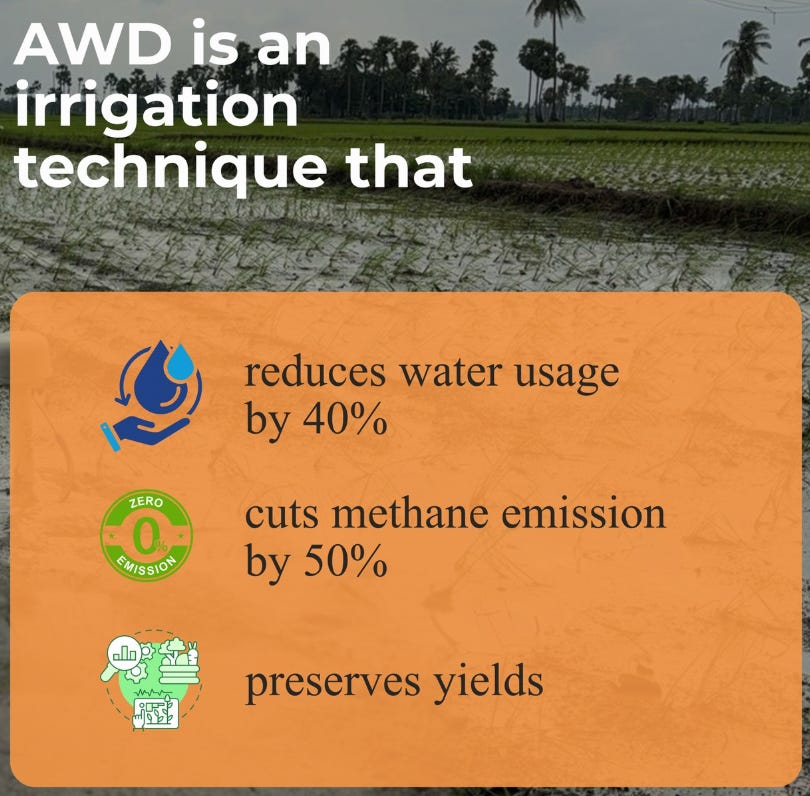
Let’s work together… Mitti Labs works directly with rice farmers in India to reduce methane emissions without affecting yields. It implements techniques like direct-seeded rice (DSR) — planting seeds directly in fields that don’t need to stay flooded, rather than transplanting seedlings, and alternate wetting and drying (AWD), where fields are periodically allowed to dry instead of remaining continuously submerged.
Can’t measure, can’t reduce… To measure and verify emissions from a field and the reductions achieved through its interventions, the company uses satellite imagery and radar. This technology can penetrate clouds, plants, water, and soil to reveal what’s happening underground, where microbes produce methane. Its AI models are trained on satellite data and extensive field studies conducted by its agents.

Why should a farmer sign up… Verified emissions reductions are converted into methane-reduction carbon credits. Mitti tracks these in its software, takes a percentage of credit sales, and passes the remainder on to farmers and the community.
Rize
Different geographies… Rize works with rice farmers in Vietnam and Indonesia, helping them implement alternate wetting and drying (AWD) across their fields. As fields are allowed to alternately dry, farmers can save energy and water. This lowers costs, making it an appealing option—and it reduces methane emissions too.


Going beyond emissions… Most of the farmers Rize works with are smallholder farmers. Before each season, they buy essential inputs like rice seeds, fertilisers, and pesticides on loans with 10–15% interest. Rize leverages its relationships with farmers to procure these inputs in bulk and sell them at a lower rate.

There’s more… Rize also works with farmers to offer a range of rice by-products, such as husk pellets, rejected rice, rice bran, and rice flour. It has also developed a rice carbon credit program. The carbon impacts of its partners are recorded and verified through a Measurement, Reporting, and Verification (MRV) system that strictly complies with Gold Standard Methodology.
What Else Did I Publish Recently
In the past 5 years, I have written 800+ long-form articles on sustainability. From newsletters and blogs to whitepapers and case studies across B2B and B2C brands.
If you run a sustainability-focused brand and need help with your long-form content, let’s chat. Hit reply, and we will take it from there :)
Quiz answer: Bangladesh


Give that 💚 a little tap if this edition helped you learn something new about sustainability and climate change. Have a good weekend and see you next week :)